





By Long Guoyi
From towering mountains to boundless seas, bridges now span across China's vast land, transforming once-isolated regions into seamlessly connected landscapes. In recent months, a string of new bridges have come into service, drawing wide public attention.
In southwest China's Guizhou province, the Huajiang Grand Canyon Bridge, hailed as the world's tallest and longest-span bridge, has become a new tourist attraction following its inauguration.
In Badong county, central China's Hubei province, the newly completed Yesanguan Bridge has shortened the travel distance between Yesanguan township and the Yesanguan railway station by approximately 10 kilometers.
In Jilin city, northeast China's Jilin province, the Hongqi Bridge spans the Songhua River, easing rush-hour congestion and improving urban mobility.
Bridge by bridge, these monumental structures now stretch across rivers, lakes, seas, and valleys, linking mountain ranges and communities. Each serves not only as critical infrastructure but also as a powerful symbol of China's economic and social progress.
These record-breaking projects underscore China's emphasis on self-reliance and technological innovation. The Shenzhen-Zhongshan Link in the southern province of Guangdong, with a clearance of 91 meters above sea level, is now the world's highest sea bridge. The Aizhai Bridge in central China's Hunan province has set multiple world records, while the Tian'e Longtan Bridge in Guangxi Zhuang autonomous region is the world's first steel-reinforced concrete arch bridge exceeding 600 meters in span.
Such engineering milestones have filled key technical gaps, established China's own engineering standards, and strengthened a fully independent industrial chain. At the core of these achievements is a strategy-driven commitment to original scientific research and breakthrough innovation in critical technologies.
China’s bridge boom also reflects the vibrancy of its vast domestic market. Each new bridge resolves logistical bottlenecks and enhances regional connectivity. Since its opening, the Hong Kong-Zhuhai-Macao Bridge has repeatedly broken traffic records and become a crucial artery of regional integration in the Guangdong-Hong Kong-Macao Greater Bay Area. The total import and export value through Zhuhai port had exceeded 1 trillion yuan ($140.4 billion).
The Changtai (Changzhou-Taizhou) Yangtze River Bridge in Jiangsu province has reduced travel time between Changzhou and Taizhou from 80 minutes to just 20, sharply increasing regional mobility. Within a month of its opening, cargo throughput at Changzhou's Lu'anzhou Yangtze terminal recorded double-digit growth.
By bringing regions closer together, these projects accelerate economic activity and reinforce efforts to create a unified national market.
Beyond economics, China's bridges reflect a deep commitment to inclusive development. In remote areas, bridges link urban and rural communities, embodying the principle that "no one should be left behind on the road to socialism."
Over a decade ago, an iconic image captured two sisters crossing the roaring Nujiang River in Nujiang Lisu autonomous prefecture, southwest China's Yunnan province, via a ropeway to reach school. That scene epitomized the challenges faced by remote communities. Today, with initiatives like "ropeways-to-bridges," such perilous crossings have been replaced. The completion of the Qiaoma Bridge transformed local access, enabling communities to pursue new development opportunities.
"We're living a life we never dared to dream of," the sisters said. Each bridge serves as a passage to progress, transforming local landscapes, facilitating trade, and integrating remote communities into the national modernization process.
Across the country, many bridges are under construction. As more of them open to traffic, they will continue to tell new stories of innovation, connection, and shared development.
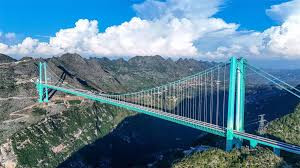
The Huajiang Grand Canyon Bridge, the world's tallest bridge, in southwest China's Guizhou province opens to traffic, Sept. 28, 2025. (Photo/Li Yunfeng)

Tourists take photos on the Huajiang Grand Canyon Bridge in southwest China's Guizhou province, Sept. 28. (Photo/Liu Zhaofu)
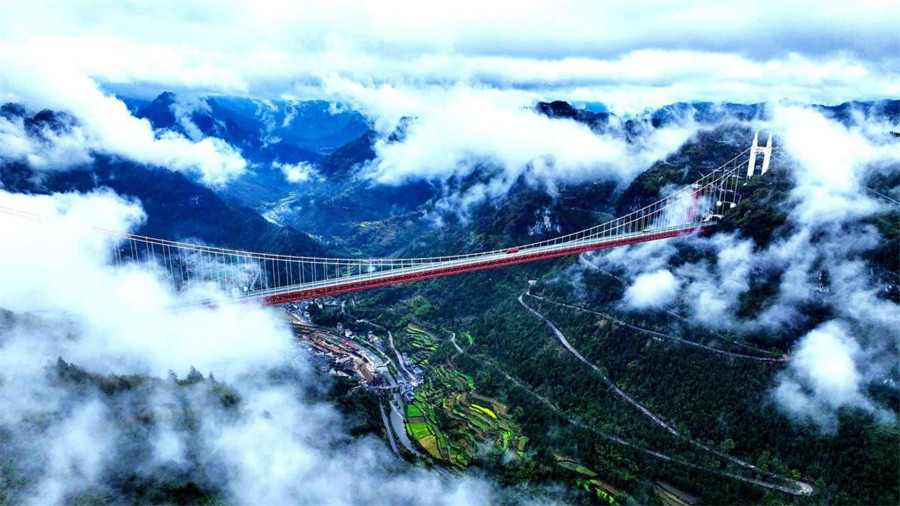
Photo shows the Shenzhen-Zhongshan Link in south China's Guangdong province. (Photo/Chen Zhiqiang)
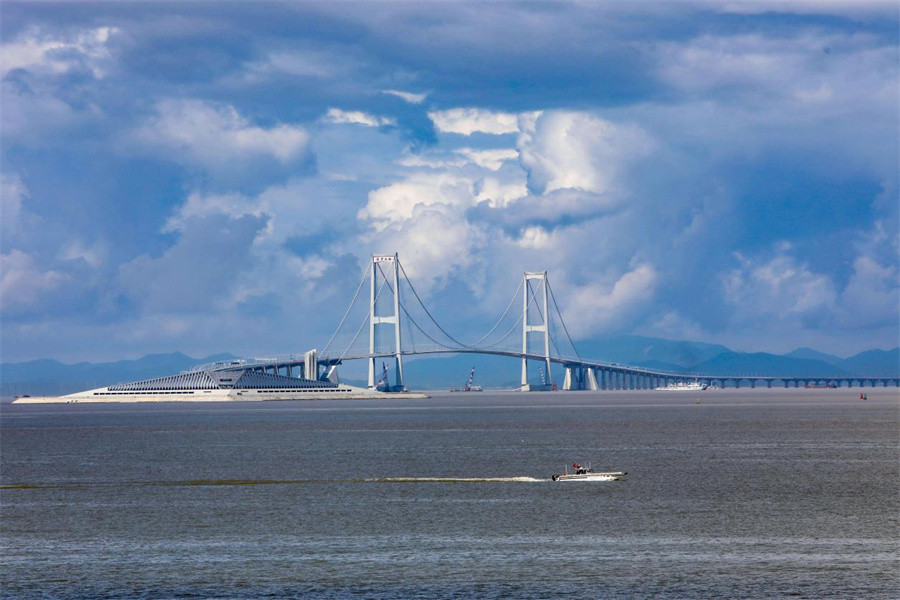
Photo shows the Aizhai Bridge in Xiangxi Tujia and Miao autonomous prefecture, central China's Hunan province. (Photo/Gong Gaoxiang)