










By Wu Yuehui, Liu Jiaru
From Earth, only the moon's near side is visible, marked by expansive dark plains (maria) and dense impact craters. Its far side, perpetually hidden due to tidal locking, long remained largely unexplored. This scientific enigma is now being systematically addressed.
In June 2024, China's Chang'e‑6 lunar probe brought back samples collected from the moon's far side for the first time in human history. Four studies on the lunar samples from the research teams from China's Institute of Geology and Geophysics, China's National Astronomical Observatories of the Chinese Academy of Sciences, Nanjing University, and other institutions were recently published in the latest issue of Nature.
The moon's two hemispheres exhibit striking differences: the near side features relatively flat volcanic maria, while the far side is dominated by rugged highlands with thinner basaltic coverage and a thicker crust. What explains this striking dichotomy?
"The samples collected by Chang'e‑6 came from the South Pole-Aitken Basin, the largest, deepest and oldest basin on the moon, which provided a rare opportunity to clarify the compositional differences between the near and far sides and to unravel the long-standing mystery of their asymmetry," explained Wu Fuyuan, an academician of the Chinese Academy of Sciences.
The Chang'e-6 samples exhibit unexpected physical properties compared to Chang'e‑5 samples. "The Chang'e‑5 samples are jet-black and nearly pure basalt, while the Chang'e‑6 samples are lighter and even whitish, due to the presence of abundant highland material composed of white anorthosite," Wu elaborated.
Unlike the electrostatically active Chang'e‑5 soil, the Chang'e‑6 samples are unexpectedly "well‑behaved," showing no notable static. Where Chang'e‑5 soil collapses readily like dry sand, Chang'e‑6 soil maintains cohesion on steep slopes.
Researchers attribute these characteristics to particle morphology and interparticle adhesion - an intriguing physical puzzle with direct implications for future lunar base construction, including the potential to fabricate "lunar bricks" using lunar soil.
The lunar mantle, located between the crust and core, approximately 60-1,000 kilometers beneath the lunar surface, holds critical evidence regarding the Moon's formation, magmatic evolution, and resource distribution.
According to prevailing theories, the moon formed approximately 4.5 billion years ago when a Mars-sized celestial body collided with the early Earth, ejecting material that eventually coalesced into the moon. The immense heat from this event likely left the mantle depleted of water, said Hu Sen, a research fellow with China's Institute of Geology and Geophysics.
However, in the past two decades, debate has persisted within the academic community over whether the lunar mantle is truly dry.
To investigate, researchers analyzed basaltic fragments collected by Chang'e‑6 to assess the water content in the mantle source region. "During lunar evolution, assessing the melting of the mantle gave rise to basalts on the surface. By examining these basalts, we can probe the secrets of the lunar mantle," Hu said.
The findings indicate that the mantle source region of the Chang'e‑6 basalts is extremely dry - containing only 1-1.5 micrograms of water per gram - marking the lowest value ever recorded. This is significantly drier than the mantle beneath the near side, potentially a result of the ancient impact that formed the Aitken Basin and altered the local mantle's water content.
Nature's peer reviewers highlighted this as the first direct measurement of water in the far-side lunar mantle, a milestone achievement in lunar science.
In addition to this breakthrough, the research team has also made advances in understanding volcanic activity and ancient lunar magnetic fields on the moon's far side. With ongoing studies of Chang'e‑6 samples, further discoveries are expected. These precious materials from the far side of the moon will continue to shed light on the evolutionary mysteries of the moon and the broader questions about the formation and dynamics of terrestrial planets.
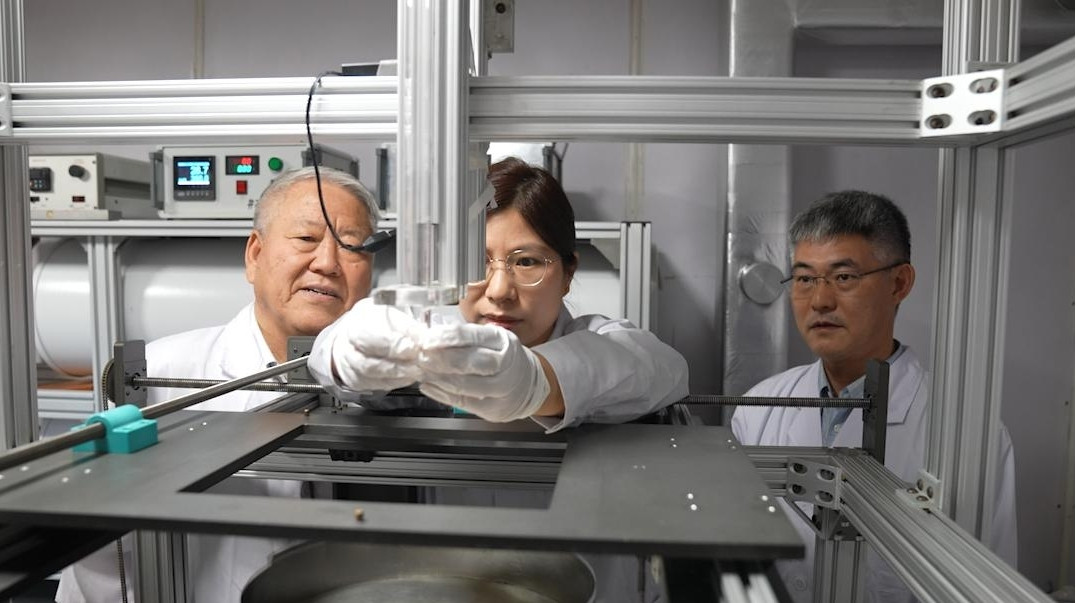
Researchers from the Institute of Geology and Geophysics, Chinese Academy of Sciences, place lunar soil samples into a superconducting magnetometer. (Photo provided by the Institute of Geology and Geophysics, Chinese Academy of Sciences)
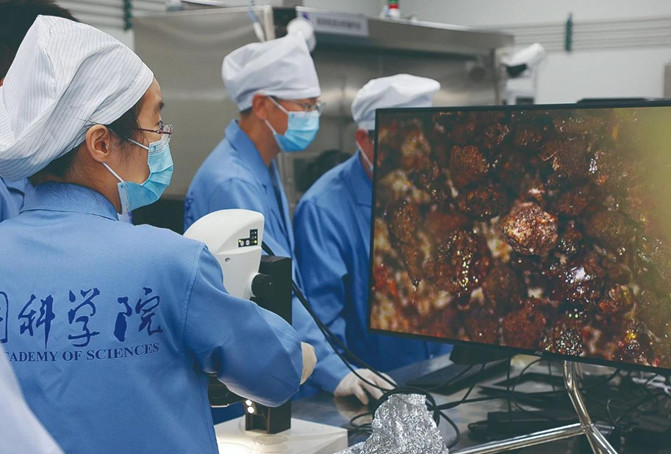
Researchers from the National Astronomical Observatories, Chinese Academy of Sciences, examine microscope images of lunar rock fragments. (Photo provided by the National Astronomical Observatories, Chinese Academy of Sciences)