







By Xu Jun,
As China convenes its annual "two sessions" - the gatherings of the National People's Congress (NPC) and the National Committee of the Chinese People's Political Consultative Conference (CPPCC), the country's legislative process has once again come under the spotlight.
In China's legislative system, the NPC and its Standing Committee serve not only as the lawmakers but also as conduits for public sentiment. But how are these voices channeled into the heart of law-making?
The answer is found in a meticulously designed institutional framework that ensures public sentiment is woven into every stage of the law-making process.
Proposing legislation
During the second session of the 14th NPC in 2024, deputies submitted 298 motions, with 292 directly addressing legislative issues ranging from the formulation and revision of laws to their repeal and interpretation.
When formulating its legislative plan, the NPC Standing Committee carefully reviews deputies' motions and suggestions alongside expert analysis and public feedback. Since NPC deputies come from all walks of life, this process allows public voices to directly contribute to the legislative process.
Drafting law
Many might be surprised to learn that even high school students' recommendations can influence Chinese national legislation. A 2020 proposal from teenagers at the High School Affiliated to East China University of Political Science and Law was relayed through a local legislative outreach office. It later appeared in revisions to China's Minor Protection Law.
Such outreach offices was first launched in 2015. Since then, over 90 percent of laws drafted or amended by the NPC and its Standing Committee have incorporated feedback from these offices, which collect opinions from businesses, villages, and schools. Officials describe them as "direct hotlines" for democracy.
The process was tested during the drafting of China's Civil Code, a landmark law enacted in 2020. Over 425,000 people made 1.02 million recommendations online. The final text added the "Personality Rights" section - a win for advocates who emphasized the need for enhanced protection of personal information, privacy, and reputation in the digital age.
Adopting law
Draft legislation generally undergoes several rounds of scrutiny by the NPC Standing Committee, and in some cases, is also examined during an NPC session.
Even technical provisions can ignite fierce discussions. In 2015, for instance, deputies clashed over a single sentence in draft revisions to China's Legislation Law, as they discovered that the third reading had removed the clause requiring tax rates to be established by law.
Why did this detail matter?
Some deputies argued that tax rates are an essential element of taxation - without a statutory mandate, the principle of statutory taxation would be compromised. In response, the NPC's specialized committees meticulously examined each suggested revision and ultimately restored the provision mandating that tax rates be set by law.
The Legislation Law, which governs how laws are made, stipulates that legislation shall uphold and develop whole-process people's democracy, respect and protect human rights, and safeguard and promote social fairness and justice.
From the initial proposal of a legislative project to the drafting and deliberation of bills, the input of public voices is actively sought and integrated - a clear demonstration of whole-process people's democracy.
Legislative power is lies at the heart of national governance. Through science-based and effective institutional arrangements, China ensures that the people exercise state power through the system of people's congresses, firmly placing the country's future firmly in the hands of its people.
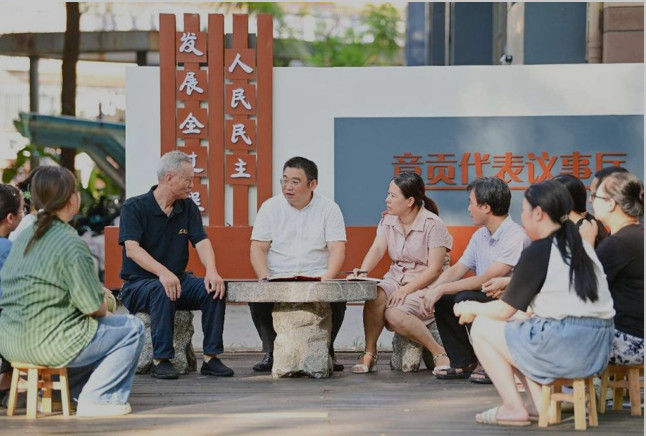 A legislative liaison officer consults residents in Ganzhou, east China's Jiangxi province, Sept. 9, 2024. (Photo by Hu Jiangtao/People's Daily Online)
 Residents submit proposals to deputies in Tongling, east China's Anhui province, Apr. 26, 2024. (Photo by Chu Zhuchuan/People's Daily Online)
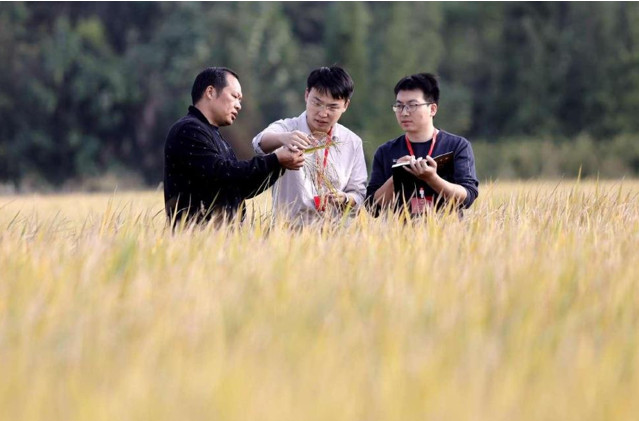 A local deputy gathers suggestions on farmland policy in Ji'an, east China's Jiangxi province, Oct. 25, 2024. (Photo by Chen Fuping/People's Daily Online)