








By Chen Junyi,
The Shui script is the unique traditional writing system used by the people of the Shui ethnic group in southwest China's Guizhou province to keep records of their astronomy, calendar, meteorology, folklore, and religion, just like ancient China's bronze and oracle bone inscriptions.
It serves as an encyclopedia for the Shui people and is hailed as a "living fossil" of pictographic writing. Even today, this traditional writing system still plays an important role in the Shui people's social life. In 2006, it was listed as China's national intangible cultural heritage.
The Shui script has been passed down for thousands of years and is primarily preserved in handwritten manuscripts. Due to the limited number of characters, it is common for characters to have multiple pronunciations and meanings, which require specialized scholars to interpret these polyphonic and polysemic words based on the context.
The scholars must be well-versed in Shui customs and uphold Shui moral principles to effectively preside over local customs activities and provide guidance for important events such as weddings and funerals.
Yang Shengzhao is a 70-year-old Shui script scholar. He started studying Shui writing with the help of his elders when he was 14. Now, he has become a representative inheritor of China's provincial-level intangible cultural heritage.
According to Yang, the customs associated with the Shui script consist of two parts. The first part is the handwritten copies that have been passed down through generations, which he refers to as the "hardware." The second part involves the contents such as essentials, rituals, and blessings that have been orally transmitted over time, which he calls the "software."
"The second part represents a significant 70 percent of the Shui script customs," Yang said.
The Duan Festival is the most important event of China's Shui ethnic group, much like the Spring Festival is for the Han Chinese. The celebration typically occurs from late August to early October of the Chinese lunar calendar, with the precise timing determined by the Shui calendar.
The ancestral worship ceremony is an important ritual during the Duan Festival, during which a Shui script scholar often recites a passage to pray for blessings from ancestors.
"This oral passage is not recorded in the handwritten copies of the Shui script, but it follows a predetermined procedure and rhythm and must not be improvised," Yang said. He believes that these orally transmitted contents are crucial in the customs of the Shui script, yet they are facing the risk of being lost.
After retiring from his position as a primary school teacher in 2015, Yang devoted himself wholeheartedly to the inheritance and preservation of the Shui script. He initiated Shui script courses at local schools, welcoming anyone interested in the Shui script to join. So far, the number of students has exceeded 100.
"Studying the Shui script might not bring immediate economic benefits, but currently, there are few successors to carry on the tradition. Without creative ways of inheritance, it would soon vanish," said Yang.
Yang also joins the protection and utilization programs initiated by the local government. In November 2022, "Shui Character Documents, Guizhou Province" was included in the UNESCO Memory of the World Committee for Asia and the Pacific Regional Register, marking a historic achievement as the first of its kind for the province.
During the application process, Yang recorded the oral contents of the Shui script and recited and translated its texts, contributing to the improvement of the application documents.
Because there are few written texts and the Shui script does not directly align with the everyday spoken language of the Shui people, teaching Shui writing cannot follow the same methods used for teaching Chinese.
"To save the Shui writing system, it requires a certain amount of financial support to annotate the script with international phonetic symbols, translate orally transmitted materials into Chinese, and record them into videos and audio," Yang noted. He believes that transforming the "software" of the Shui script into a tangible "hardware" is crucial for ensuring its continuity.
Promoting the Shui writing system to the world is also an aspiration of the Shui people. In 2014, at the 63rd meeting of the International Organization for Standardization, the Chinese delegation submitted a proposal on the international coding of the Chinese Shui script. Over the years, a local expert group has been continuously improving the application documents.
"If the application is approved, the Shui script will gain an 'identity card' globally, allowing the written manuscripts to be disseminated electronically across different parts of the world, thereby promoting our culture even further," said Yang.
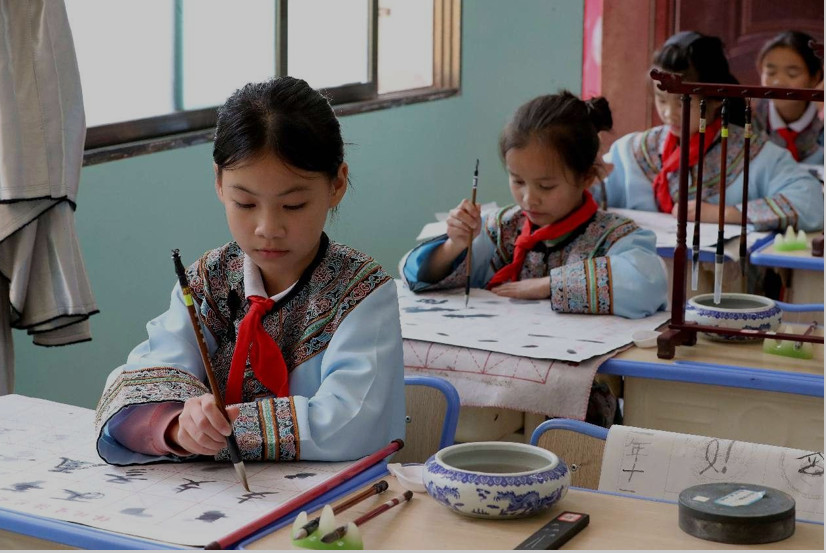 Students practice Shui writing at a school in Rongjiang county, southwest China's Guizhou province. (Photo by Li Changhuua/People's Daily Online)
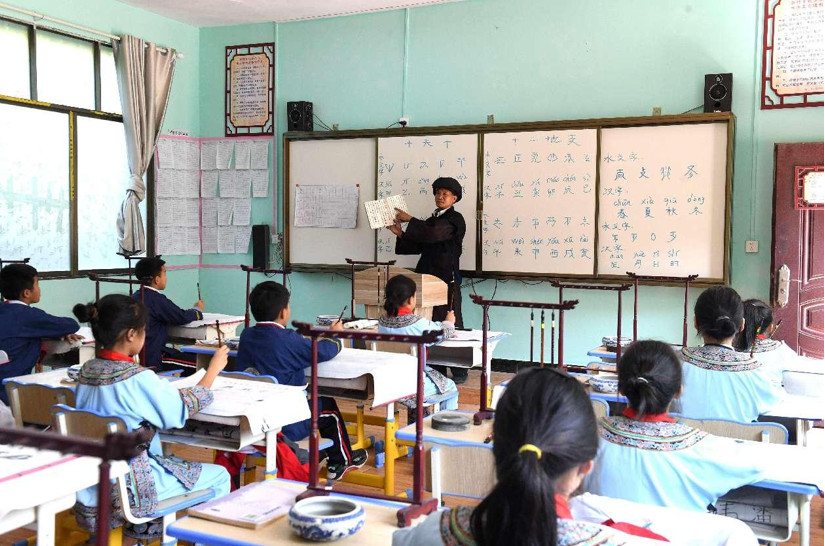
A teacher teaches the Shui script at a school in Rongjiang county, southwest China's Guizhou province. (Photo by Yang Chengli/People's Daily Online)