







By Luo Shanshan,
The Regional Comprehensive Economic Partnership (RCEP) agreement took effect for all its 15 members on June 2 last year, which marked the start of a new stage for the trade bloc with the world's largest population and trade volume as well as the greatest development potential.
Over the past year, the RCEP has greatly facilitated the free flow of production factors within the region, including raw materials, products, technology, talent, capital, information, and data. It has gradually fostered a more prosperous integrated market for the region and promoted cooperation in more areas, on higher levels and in greater depth.
According to statistics, intra-regional trade in the RCEP region reached $5.6 trillion last year, slightly higher than that of 2021 when the agreement was not in effect. Regional industrial and supply chain cooperation has become increasingly close. In 2023, the RCEP region attracted $234.1 billion in greenfield investments, a surge of 29.8 percent year-on-year and more than double the number from 2021.
For businesses, the most direct benefit of RCEP lies in tariff reductions. Over 90 percent of goods traded within the region will eventually be tariff-free.
Recently, a cargo ship carrying 6,000 tons of imported benzene docked at a pier in Huizhou Port, south China's Guangdong province. After on-site inspection and sampling by customs officers from Huizhou Customs, this batch of imported benzene was quickly unloaded into a tank area and transported through pipelines to a facility of CNOOC (China National Offshore Oil Corporation) and Shell Petrochemicals Company Limited for further processing.
It was the eighth batch of benzene imported by CNOOC and Shell Petrochemicals Company Limited this year with preferential tariff treatment under the RCEP.
Zhou Xin, the company's customs declaration manager, said, "The tariff for benzene imported from Vietnam has been reduced from 2 percent to 0, saving us nearly 7 million yuan ($962,953) in costs. This allows us to expand our imports, thus better meeting the demand of the domestic market for raw benzene."
Tariff reduction has brought tangible benefits to businesses. In 2023, Chinese companies saved 2.36 billion yuan in taxes on 90.52 billion yuan of imports under the RCEP.
"Since the implementation of the RCEP, our overseas customers have saved nearly 2.53 million yuan in tariff costs, thanks to the RCEP Certificates of Origin issued by the customs. This is of great significance for maintaining our overseas customers," said Zong Qiaoling, customs manager of a home tech company.
According to Zong, the company has applied for 80 RCEP Certificates of Origin from January to May this year, with a total cargo value of over 34 million yuan.
Certified exporter system is one of the highlights of the RCEP. Companies that have obtained certified exporter status can issue origin declarations themselves, which carry the same effect as Certificates of Origin issued by customs authorities.
Changfa Agriculutral Equipment in east China's Jiangsu province obtained certified exporter status this year. Hu Xiangbao, vice general manager of the company's overseas marketing, said, "Now we can issue origin declarations at any time, making trade more flexible and efficient. This status also helps us improve our image and strengthen relationships with our foreign trade partners."
Since the RCEP agreement came into force, member countries have further relaxed market access in areas such as goods, services, and investment, promoting the gradual harmonization of rules of origin, customs procedures, inspection and quarantine, and technical standards. This has accelerated the free flow of economic factors within the region, leading to closer cooperation in industrial and supply chains.
The implementation of the RCEP has led to closer trade and investment ties between China and other member countries.
Steady progress has been made in trade in goods. China's total imports and exports with the other 14 RCEP members reached 12.6 trillion yuan in 2023, representing a 5.3 percent increase from 2021.
Investment cooperation has also been on the rise. China's non-financial direct investment inflows into other RCEP member countries increased 26 percent year on year to hit $18.06 billion in 2023, outperforming China's global average growth rate in investment by 14 percentage points.
To promote the high-quality implementation of the RCEP, the China Council for the Promotion of International Trade (CCPIT) has held dozens of economic and trade activities, such as the High-level Forum for RCEP Economic and Trade Cooperation. Additionally, hundreds of online and offline training sessions have been conducted, benefiting hundreds of thousands of enterprises. The CCPIT has also published practical manuals to provide assistance to enterprises in effectively utilizing the RCEP.
An official with the Ministry of Commerce said that China will fully leverage its role as the co-chair of the RCEP this year to lead the high-quality implementation of the trade pact and boost the agreement's regional impact.
At the same time, the country will continue to provide support and services to help enterprises effectively utilize and benefit from the preferential measures under the RCEP and other free trade agreements, the official added.
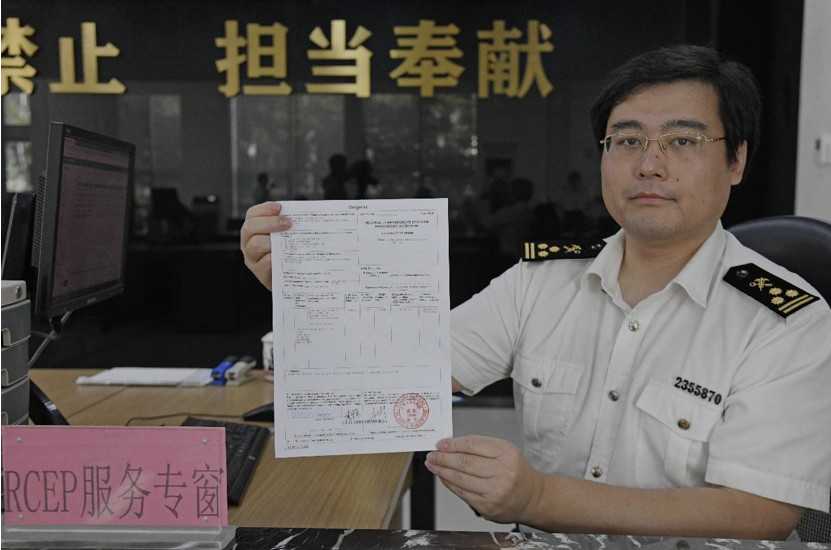 Changzhou Customs issues Jiangsu province's first RCEP Certificate of Origin for exports to the Philippines, June 2, 2023. (Photo by Xia Chenxi/People's Daily Online)
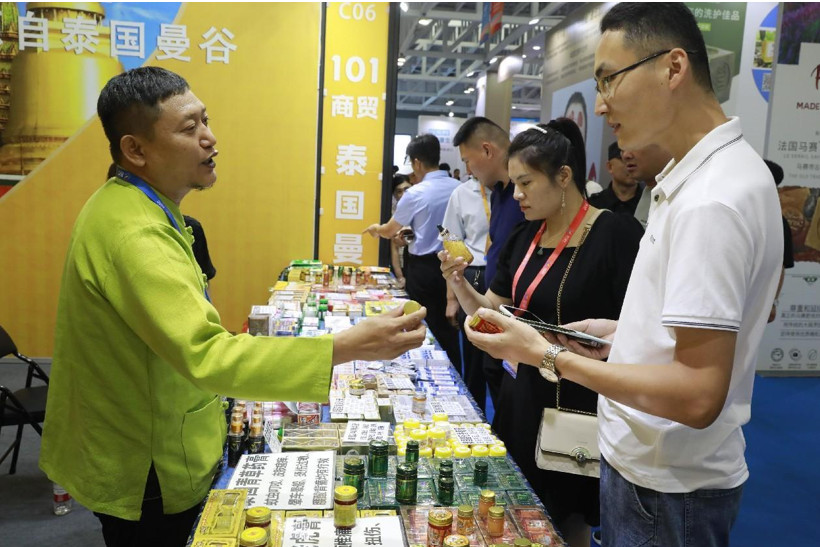 A Thai merchant sells Thai commodities at the third RCEP (Shandong) Import Expo, Aug. 18, 2023. (Photo by Sun Lei/People's Daily Online)